Beyond Basic Bots: Why Custom Slack Solutions Matter
5 min to read
Beyond Basic Bots: Why Custom Slack Solutions Matter
Slack is basically the new office. It's the central hub. And with hybrid/remote work basically being permanent (McKinsey says 90% of companies are in), it's not just a chat tool, it's the command center.
The problem is, the more you actually rely on it, the more you realize those standard, off-the-shelf bots from the app store just don't cut it. They're generic. They're fine for a simple "Google Drive updated a file" alert, but they don't solve your team's real, specific, messy problems.
That's the whole reason custom bots are becoming such a big deal. People are tired of workarounds.
What’s the Real Deal: Custom vs. App Store?
The out-of-the-box (OOTB) stuff is exactly what you'd expect. You install it, it is either cheap or free, and it does one or two straightforward tasks, such as sending Trello card alerts. It acts immediately, and there is no need to take care of it.
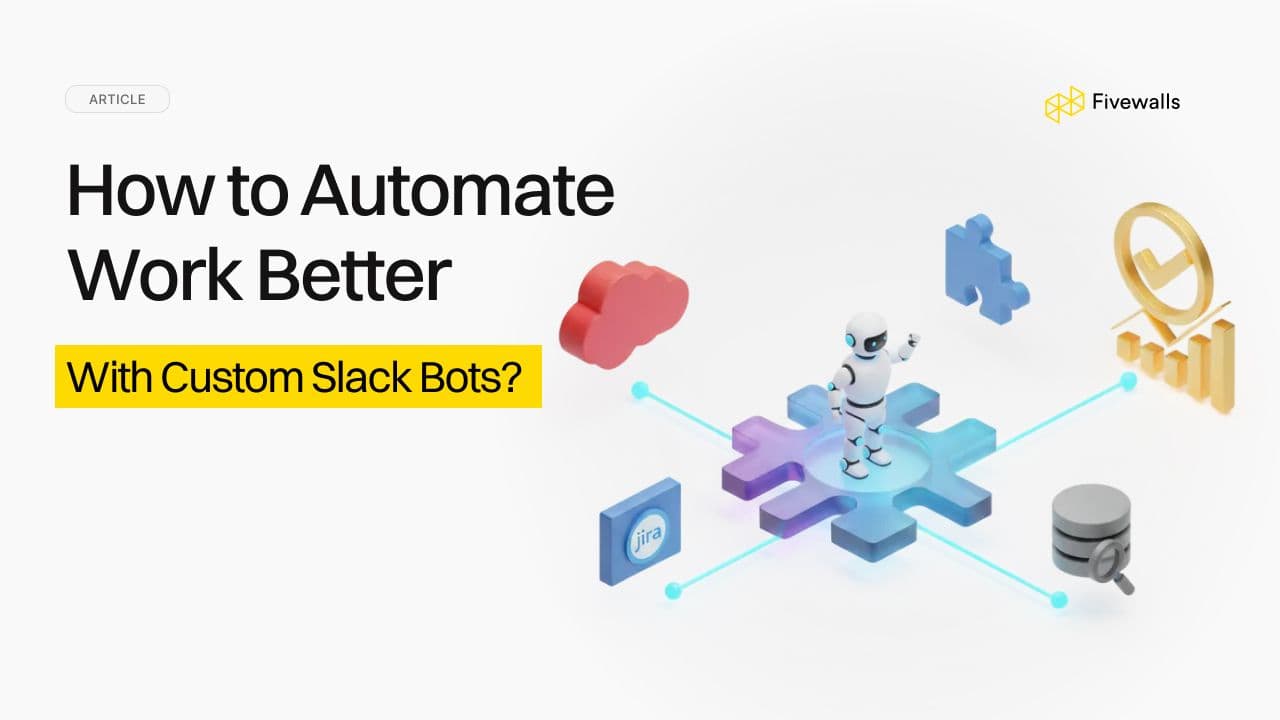
However, when you get the response of your sales ops manager, who says, I need a bot that pulls lead data on our proprietary CRM, cross tabulates it with our internal PostgreSQL database to view their support history, executes our own lead-scoring algorithm, and sends a high-priority summary back to the #sales channel, what do you do? The App Store bot can't do that. That's a custom job.
We actually built one for a client that did something similar. Their sales team could get a full client history and respond 40% faster, all because they weren't wasting 10 minutes alt-tabbing between five different systems.
Technically, you're not building a massive program. You're just building a small, secure web application. It uses OAuth2 to get the right permissions from Slack (like commands or chat: write), and then waits for webhooks. When a user types your command, Slack pings your app's endpoint.
Your app is running on something cheap and simple like AWS Lambda or Google Cloud Run. It grabs the data, does its logic (using Slack's Bolt SDK makes this part way easier), and fires a formatted message back.
Now, you've also got that massive middle ground: Zapier and Make (which used to be Integromat). These things are powerful for low-code automation. You can chain together a bunch of apps and build some really impressive workflows. But you will hit a wall.
You can be stuck inside their sandbox. The second you need to talk to an internal-only API, or run complex business logic that isn't just "if-this-then-that," you're back to square one: you need custom code.
That Sounds Expensive and Complicated?
People hear "custom" and they immediately think "costly," "complex," and "long development time." And they're not wrong, it's a higher initial investment. There's also the fear of "over-automation," where you lose the human touch.
But a good custom bot isn't about replacing people. It's about being an assistant who does the dumb, repetitive parts of the job.
A real-world example of this is the project that our team at Fivewalls did for RIOT Games. They had an issue with how leadership communication was being handled. We built a custom Q&A bot specifically to structure those discussions, which helped improve engagement and made it possible to actually track internal Q&A sessions. This was about building a specific tool to solve a specific, high-level communication problem that a generic polling bot just couldn't handle.
This Stuff Gets Really Niche
The real power is in how specific it can get for different industries.
In healthcare, you can't just install a random bot from the app store. It's a HIPAA compliance nightmare. But a custom bot? You build it from the ground up to be secure. It can integrate directly with an Electronic Medical Record (EMR) system for appointment reminders, and you know it's secure.
In retail or e-commerce, it's way beyond simple "low stock" alerts. A custom bot can tie into your inventory database, your supplier's API, and your marketing and sales data. It could see a product is suddenly trending on TikTok, check your stock levels, see you're running low, and automatically adjust reorder volumes based on that real-time demand. That's advanced business logic, not just a simple alert.
The Future: Bots That Actually Think
And this is all before we get to the AI and ML stuff that's really taking off. Bots are moving from just reacting to commands to actually predicting things.
We're starting to see predictive automation. Imagine a bot that watches your project management tool. It says, "Based on the team's current workload and the last three sprints, Project A is 90% likely to be late in two weeks unless these three specific tasks are re-assigned." That's actually useful.
Or sentiment analysis. It's a little creepy, but a bot could monitor the general vibe in a project channel and send a private nudge to a manager: "Hey, the language in #launch-project has been really negative for 48 hours. Might be time to check in." It's about spotting burnout or a major roadblock before it blows up.
Why Use Custom Slack Bots?
At the end of the day, custom Slack bots are about fixing the very specific, annoying, time-wasting gaps in your company's workflow. They let your expensive, smart team members stop doing data entry and actually do their jobs.
If your organization is stuck in that "copy-paste-between-tabs" hell, it's probably worth looking into. If you want to talk about how a solution might fit your goals, our team is available. We can figure out if it actually makes sense.
Would you like to rate this article?